
Introduction
Picture this: you're halfway through a butchering task, game-processing session, or survival scenario, and you reach for a standard hacksaw blade to cut through bone. Within the first inch, the blade clogs with a greasy paste of marrow and bone dust, slowing to a frustrating crawl and producing a rough, splintered cut that defeats the entire purpose.
Not all hacksaw blades are built for bone. Choosing the wrong one wastes effort, damages the cut, and dulls the blade prematurely. In practice, bone marrow and sawdust accumulate in fine-toothed blade gullets, creating an abrasive paste that degrades cutting efficiency and causes rapid tooth wear.
The right blade — with the correct tooth count, material, and set pattern — makes the task clean, controlled, and efficient. This guide breaks down exactly what to look for so you can match the blade to the job.
Key Takeaways
- Standard hacksaw blades clog quickly on bone—they're designed for metal, not biological material
- Choose coarse blades with 10–18 TPI, deep gullets, and wavy or raker tooth set patterns for effective chip clearance
- Bi-metal or high-speed steel (HSS) blades outperform carbon steel for durability and heat resistance
- Wire saw blades cut in any direction without frame constraints, making them well-suited for surgical, field, and confined-space applications
- Match blade type to your context: dedicated bone saw blades for butchering, wire saws for compact multi-angle cutting
Why Standard Hacksaw Blades Fall Short When Cutting Bone
Standard hacksaw blades are engineered for cutting metal, not biological material. They feature fine teeth (24–32 TPI) and shallow gullets designed to take small, precise bites through uniform, dense materials like steel or aluminum. That geometry works against bone's fibrous, porous structure from the first stroke.
The Clogging Problem
Bone's density and marrow content cause fine-toothed blades to pack with sawdust and marrow residue within the first inch of cutting. Research examining saw marks on bone documents how this greasy paste accumulates in tooth gullets, acting like an abrasive compound between the blade and kerf wall. This clogging slows progress, generates excess heat through friction, and accelerates tooth wear.
The Kerf Binding Issue
A standard hacksaw blade produces a narrow kerf suited to metal cutting, where minimal material removal is desirable. But bone requires a wider, cleaner kerf to prevent binding and allow debris to escape. Dedicated bone saw blades feature larger, wider-set teeth that create a kerf wider than the blade body itself, preventing the saw from pinching in deep cuts.
Premature Wear and Splintering
Using the wrong blade increases the risk of tooth stripping and premature blade failure. As cutting progresses, the sharp points at tooth apexes become rounded off. Polishing wear then follows on the outside tooth faces due to constant friction against bone and marrow residue. The consequences depend on context: in food preparation, rough cuts create surfaces that harbor bacteria; in medical and forensic work, degraded blade geometry compromises cut quality where accuracy is critical.
What to Look for in a Hacksaw Blade for Cutting Bone
Choosing the right blade requires matching four key specifications to bone's unique properties: TPI, blade material, tooth set pattern, and blade form factor. Get any one wrong and you'll face clogging, blade failure, or splintered cuts.
TPI (Teeth Per Inch)
Lower TPI equals larger teeth with deeper gullets, which is critical for bone. The gullets carry debris out of the cut instead of packing it in. While hardware stores commonly stock 24–32 TPI blades for metal, bone cutting demands a dramatically coarser profile.
Recommended TPI ranges:
- 10–11 TPI: Industry standard for heavy bone and carcass splitting, used by professional butcher saw manufacturers like Kasco, Alfa, and Cozzini
- 14–18 TPI: General-purpose bone cutting for medium-sized bones; suitable for game processing and survival applications
- 24–32 TPI: Metal-cutting standard; completely unsuitable for bone due to immediate clogging
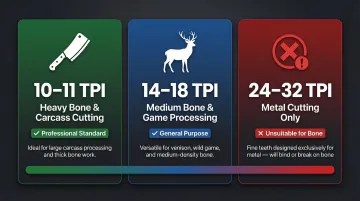
TPI selection also depends on bone size. Larger, denser bones (femur, leg bones) benefit from the coarsest end of the range, while smaller bones (ribs, poultry) can tolerate slightly higher TPI without excessive splintering.
Blade Material
The metallurgical composition determines edge retention, shatter resistance, and heat tolerance during friction-intensive bone cutting.
Three materials dominate the market, each with a different performance ceiling:
- Bi-metal: HSS cutting teeth electron-beam welded to a flexible spring-steel spine — the strongest option. Resists heat and dulling under heavy torque, making it the go-to for field dressing and survival use where a snapped blade has real consequences.
- High-speed steel (HSS): Strong edge retention and heat resistance; maintains sharpness longer than carbon steel through dense bone.
- Standard carbon steel: Wears quickly and prone to early failure on bone. Acceptable only for light-duty or single-use applications.
Tooth Set Pattern
The "set" of a saw blade—how the teeth are laterally bent—determines the width of the kerf and how efficiently debris is cleared. For bone cutting, two set patterns excel:
Wavy set features teeth bent in groups, creating a wave pattern. This design provides greater chip clearance and stronger teeth, making it highly effective for bone's interrupted, porous structure. The wide channel created by wavy-set teeth resists packing with bone material.
Raker set uses a recurring sequence: teeth set left and right, followed by one straight (unset) tooth. The straight raker tooth acts like a chisel to remove chips from the kerf floor, actively evacuating the greasy marrow paste that causes standard alternating-set blades to bind.
By contrast, the alternating set common to metal-cutting blades (each tooth simply bent to the opposite side) produces a narrow kerf prone to clogging.
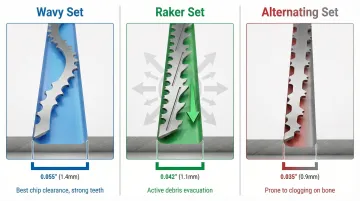
Both set patterns address the same underlying problem: bone debris management. The blade's form factor — flat or wire — takes this a step further.
Blade Type: Flat vs. Wire/Round
Beyond traditional flat hacksaw blades, wire (round) saw blades represent a distinct design. With no fixed cutting direction, they can cut at any angle and reach into spaces that a rigid flat blade cannot. This flexibility makes them valuable for irregular cuts, confined spaces, or situations where repositioning a frame saw is impossible.
Spyral Saw wire blades are used in surgical bone cutting for exactly this reason — they cut without jamming against adjacent tissue or structure. The 360-degree cutting surface allows the user to change direction mid-cut without repositioning the tool.
Types of Blades for Cutting Bone and When to Use Each
Three main blade types work for cutting bone, each suited to different contexts and precision requirements. Choosing correctly depends on whether you're in a professional butchering environment, a field setting, or a medical application where blade geometry and safety both matter.
Dedicated Bone Saw Blades
Professional bone saw blades (typically 10–18 TPI, with large raker-set or wavy-set teeth and deep gullets) are purpose-built for butchering. They produce the cleanest, fastest cuts with minimal splintering.
Specifications:
- Blade lengths: 19" to 27" (longer than standard 12" hacksaws)
- Width: 1/2" to 5/8"
- TPI: 10–11 for commercial applications
- Material: Spring-tempered or high-carbon steel, heat-treated for durability
Their extended length allows for long, smooth strokes that naturally clear debris and reduce operator fatigue. They can also be cut down to fit a standard hacksaw frame when needed.
Coarse Hacksaw Blades as a Field Alternative
When a dedicated bone saw blade is unavailable, the coarsest available hacksaw blade (lowest TPI, typically 14–18) can serve as a field alternative. Performance will be slower and rougher than a dedicated blade — expect coarser kerf edges and more frequent clearing stops.
Practical tips for using coarse hacksaw blades on bone:
- Use steady, long strokes to maximize debris clearance
- Apply light food-safe lubricant (USP white mineral oil for food applications)
- Clear the blade frequently to prevent packing
- Maintain consistent pressure without forcing the cut
- Engage at least three teeth in the material at any time to prevent snagging
Wire/Round Saw Blades for Versatile and Compact Cutting
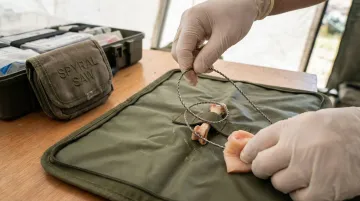
Wire saw blades are the right choice when flat blades can't follow the contour of a bone or when frame size is a constraint — field dressing, survival kits, and surgical procedures all fall into this category. Their 360-degree cutting action lets the user change direction mid-cut without repositioning the tool.
Key advantages:
- No fixed cutting direction—cut at any angle or orientation
- Fit into tight spaces where rigid frames cannot reach
- Compact and portable for survival kits and field applications
- Does not readily cut skin — significantly lower accidental injury risk than exposed flat blade teeth
That skin-safe quality is one reason Spyral Saw's wire saw blades have become the best-selling surgical wire bone saw in the U.S. — surgeons and field medics work in close proximity to soft tissue, where an errant flat blade creates real liability.
How Spyral Saw's Wire Blade Stands Apart
When the task is cutting bone, not just any wire blade qualifies. Spyral Saw, manufactured by Bestway Products Company, makes the Spyral wire blade — the best-selling surgical wire bone saw in the U.S., with over 50 years of verified use in military, aerospace, and medical applications.
360-Degree Cutting Capability
The Spyral blade's distinctive spiral tooth design creates a continuous cutting surface around the entire circumference of the wire. This means the blade cuts in any orientation or direction—forward, backward, sideways, or at any angle—without needing to reposition the tool or workpiece. This flexibility is impossible with traditional flat blades.
Performance Advantages
Reduced kerf and effort: The Spyral blade's design produces a smaller kerf than carbide rod saws, requiring less material removal per cut. This translates to faster cutting with less physical effort.
Fits tight spaces: Because the blade is a flexible wire rather than a rigid frame-mounted blade, it can reach into confined areas where a hacksaw frame cannot fit. This is critical for surgical applications, field dressing in difficult positions, or industrial cutting around obstacles.
Skin-safe design: The blade does not readily cut skin, providing a significant safety advantage in medical procedures and food handling where accidental contact is a risk.
Versatile hole saw function: The blade ends can be twisted off for use as a hole saw, allowing for internal cuts and precise hole drilling in materials ranging from wood and plastics to bone and light metals.
Proven Track Record
The Spyral blade's 50+ year track record speaks across demanding fields:
- U.S. Military — issued for survival and tactical cutting under government spec NSN 5110-00-570-6896
- Aerospace industry — used for 30+ years to trim titanium and stainless steel sheet at high speeds
- Medical and surgical — the best-selling surgical wire bone saw in the U.S.

Made in the USA with manufacturing roots going back to 1946, Spyral is a supplier teams can source consistently — same blade, same performance, same spec — year after year.
Conclusion
The right blade for cutting bone is defined by low TPI (10–18 teeth per inch), appropriate material (bi-metal or HSS), and a tooth set pattern (wavy or raker) that clears debris efficiently. Blade form—flat versus wire—depends on your application: rigid frame blades for straight, powerful cuts; wire blades for multi-directional flexibility in confined spaces.
With these specs in hand, the choice becomes straightforward. Butchers and hunters working in open space typically do well with a standard bi-metal frame blade at 14–18 TPI. For medical professionals or field use — where access is limited and cutting angle matters — a wire saw blade's 360° cutting capability makes it the more practical option. Match the blade to the job, and the cut follows.
Frequently Asked Questions
What is the best tool to cut through bones?
The best tool depends on context. A dedicated bone saw with 10–11 TPI is ideal for butchering and large carcass work. A coarse hacksaw blade (14–18 TPI) serves as a practical field alternative. Wire saw blades are the preferred choice for surgical use or compact field applications due to their multi-directional cutting ability and skin-safe design.
Can I use a regular hacksaw blade to cut bone?
A standard hacksaw blade can technically cut bone but performs poorly — fine teeth (24–32 TPI) and shallow gullets clog rapidly with marrow and bone dust. A coarse hacksaw blade with the lowest available TPI cuts better, though it still won't match a dedicated bone saw blade.
What TPI is best for cutting bone?
10–11 TPI is the professional standard for heavy bone and carcass splitting. For medium-sized bones, 14–18 TPI cuts faster without excessive splintering. Anything above 18 TPI clogs quickly and is unsuitable for bone.
What is the difference between a hacksaw blade and a bone saw blade?
Bone saw blades use fewer, larger teeth (10–18 TPI) with deeper gullets and a wider wavy or raker set to prevent clogging in dense biological material. Standard hacksaw blades have fine teeth (24–32 TPI) optimized for metal — their shallow gullets pack with bone marrow almost immediately.
How do I prevent a blade from clogging when cutting bone?
Start with the coarsest blade available, then follow these steps:
- Apply a light food-safe lubricant (USP white mineral oil works well)
- Use long, steady strokes to clear debris from the gullets
- Stop periodically to remove accumulated material from the teeth
- Choose blades with wavy or raker tooth set patterns for better chip clearance