
This guide covers the top 10 wire saw blade manufacturers serving Michigan—including both Michigan-based producers and nationally recognized specialists with proven supply chains to the state. Each supplier was evaluated on product quality, industry credentials, material versatility, and verified use in aerospace, defense, and medical applications.
Key Takeaways
- Wire saw blades are round-profile, flexible cutting tools designed for multi-directional cutting in metals, plastics, ceramics, and bone
- Michigan's aerospace and automotive sectors require suppliers with material versatility, compliance credentials, and reliable lead times
- Spyral Saw (Bestway Products Company) makes the only 360° multi-directional wire saw blade — trusted by the U.S. Military and Aerospace Industry
- Selection criteria should prioritize cutting direction flexibility, TPI range, kerf efficiency, and proven sector performance
- Verify ISO 13485, AS9100, and FDA registrations before signing long-term supply agreements
Overview of Wire Saw Blades in Michigan's Industrial Market
Wire saw blades are thin, flexible, round-profile cutting tools—distinct from flat-set blades—that enable multi-directional cutting and access to tight, irregular workspaces. Unlike conventional hacksaw or bandsaw blades that cut in one direction only, wire saws navigate curves, cut backwards, and reach spaces where rigid blades fail. Applications span industrial trimming of titanium and stainless steel, surgical orthopedic procedures, military survival kits, and precision craft work.
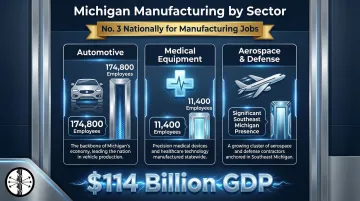
Michigan's manufacturing sector generated $114 billion in GDP in 2024, employing over 596,600 workers across more than 12,000 facilities and representing 14.2% of the state's total workforce. The state ranks No. 3 nationally for manufacturing jobs, with sector concentrations including:
- Automotive: 174,800 employees
- Medical equipment: 11,400 employees
- Aerospace and defense: significant presence across Southeast Michigan
That industrial density creates steady demand for precision cutting tools — specifically blades capable of handling aerospace-grade alloys, medical-grade bone cutting, and composite materials that defeat standard flat blades.
Given this scale, sourcing the right wire saw supplier means weighing local manufacturers, who offer proximity and faster lead times, against nationally recognized specialists with established compliance records in aerospace, defense, and medical sectors. The manufacturers below represent both categories, each evaluated for performance in demanding industrial, medical, or defense applications.
Top 10 Wire Saw Blade Manufacturers in Michigan
These manufacturers were selected based on product performance, industry reputation, material versatility, and documented use in aerospace, defense, medical, and industrial sectors. Entries 2 and 3 are Michigan-headquartered; the remaining suppliers serve Michigan buyers through national or regional distribution. Each entry includes key differentiators and supply capabilities relevant to Michigan procurement teams.
1. Spyral Saw (Bestway Products Company)
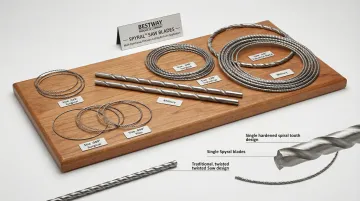
Spyral Saw is the exclusive U.S. manufacturer of the Spyral wire saw blade, a proprietary round, multi-directional blade produced continuously since 1946 (originally under Tyler Manufacturing). The company serves aerospace, military, medical, and industrial markets nationwide, including Michigan.
Key differentiators:
- Only 360° wire saw blade on the market—cuts in any orientation and direction without blade rotation
- Safe to handle; does not readily cut skin despite cutting metals, plastics, ceramics, bone, wood, rubber, and adhesives
- Trusted by the U.S. Military (Air Force, Marine Corps) and Aerospace Industry for 30+ years
- Best-selling surgical wire bone saw in the U.S., used in orthopedic and neurosurgical procedures
- Made in USA with tempered carbon steel (.040", .050", .074" diameters) and stainless steel (surgical variants)
- Blade ends can be twisted off for use as a hole saw, providing dual functionality
| Feature | Details |
|---|---|
| Key Feature | 360° multi-directional cutting; cuts metals, plastics, ceramics, bone, wood, rubber, and adhesives |
| Industry Credentials | Trusted by U.S. Military, U.S. Air Force, U.S. Marine Corps, and Aerospace Industry for 30+ years; over 100,000 units procured by U.S. Government |
| Product Availability | Multiple blade lengths (12", 20", 24", 48"); diameters (.028", .040", .050", .074"); custom fabrication available; NSN 5110-00-570-6896 compliant military survival saws |
2. Aspen Surgical
Aspen Surgical is headquartered in Caledonia, Michigan, providing direct in-state access to FDA-registered Gigli wire saw blades for medical and orthopedic applications. The company specializes in surgical-grade, multi-strand stainless steel wire saws designed for precise bone cutting with minimal kerf.
Key differentiators:
- Michigan-based manufacturer with local supply chain advantages for regional hospitals and medical device distributors
- ISO 13485 certified and FDA Registered (Establishment No. 1836161)
- Gigli wire saw blades available in 12" and 20" lengths for sterile and non-sterile surgical use
- Focuses exclusively on medical-grade precision cutting, compliant with ASTM F899 and ISO 7153-1 standards
| Feature | Details |
|---|---|
| Specialization | Gigli wire saw blades (12", 20") for orthopedic and neurosurgical bone cutting |
| Certifications / Standards | ISO 13485, FDA Registered (1836161), ASTM F899, ISO 7153-1 |
| Lead Time / Availability | In-state inventory; direct Michigan sourcing reduces lead times for healthcare networks |
3. Mopec
Mopec operates from Madison Heights, Michigan, serving medical, autopsy, and forensic markets with specialized Gigli wire saws for bone cutting in post-mortem and surgical applications. The company provides ISO-certified products with regional distribution advantages.
Key differentiators:
- Michigan-headquartered with direct access for Detroit-area medical facilities and forensic labs
- ISO certified with focus on autopsy and forensic applications
- Gigli wire saw products (12", 20") designed for high-precision bone sectioning
- Established supplier to Michigan healthcare and forensic pathology networks
| Feature | Details |
|---|---|
| Specialization | Autopsy saw wire, Gigli blades for forensic and medical bone cutting |
| Certifications / Standards | ISO Certified |
| Lead Time / Availability | Regional inventory; fast turnaround for Michigan-based medical and forensic customers |
4. Integra LifeSciences
Integra LifeSciences, headquartered in Princeton, New Jersey, is a major national supplier of Jarit and Stille branded Gigli wire saw blades to Michigan hospitals and surgical centers. Founded in 1989, the company maintains strict compliance with medical device standards.
Key differentiators:
- Stille Gigli wire saws achieve kerf widths of <1mm, critical for bone stock conservation in precision orthopedic procedures
- ISO 13485 certified and FDA Registered with extensive hospital network supply agreements
- National distribution network ensures reliable supply to Michigan healthcare systems
- Premium surgical instruments with proven clinical performance in neurosurgery and orthopedics
| Feature | Details |
|---|---|
| Specialization | Jarit/Stille Gigli wire saw blades; sub-millimeter kerf for precision bone cutting |
| Certifications / Standards | ISO 13485, FDA Registered |
| Lead Time / Availability | National distribution with established supply contracts to Michigan hospital networks |
5. Brasseler USA Surgical
Brasseler USA Surgical, based in Savannah, Georgia and founded in 1976, is a nationally recognized medical device manufacturer serving Michigan's orthopedic and surgical markets with ISO 13485-certified Gigli saw blades.
Key differentiators:
- ISO 13485 certified and FDA Registered (Establishment No. listed) with focus on surgical precision instruments
- National supplier with established distribution channels serving Michigan medical facilities
- Comprehensive medical product catalog including orthopedic cutting solutions
- Nearly 50 years of surgical instrument manufacturing with distribution to major U.S. hospital networks
| Feature | Details |
|---|---|
| Specialization | Gigli saw blades for orthopedic surgical procedures |
| Certifications / Standards | ISO 13485, FDA Registered |
| Lead Time / Availability | National distribution network; reliable supply to Michigan hospitals and surgical centers |
6. Zimmer Biomet
Zimmer Biomet, headquartered in Warsaw, Indiana, is a major orthopedic device manufacturer supplying Gigli saw blades to Michigan's medical community. The company's proximity to Michigan and extensive hospital supply agreements make it a key regional source.
Key differentiators:
- FDA Registered (Establishment No. 1822565) with focus on orthopedic and surgical instruments
- Proximity to Michigan provides regional supply chain advantages over distant national suppliers
- Established relationships with Michigan hospital networks and procurement teams
- Broad orthopedic product portfolio enables bundled procurement for surgical departments
| Feature | Details |
|---|---|
| Specialization | Gigli saw blades for orthopedic surgical applications |
| Certifications / Standards | FDA Registered (1822565) |
| Lead Time / Availability | Regional proximity (Indiana); established hospital supply agreements in Michigan |
7. Sklar Corporation
Sklar Corporation, based in West Chester, Pennsylvania, manufactures sterile and non-sterile Gigli saw wires for surgical applications, serving Michigan hospitals through national distribution channels.
Key differentiators:
- FDA Registered with specialization in sterile surgical wire saws for operating room use
- Focus on sterility and single-use surgical instruments ensures compliance with infection control standards
- National distribution network with medical device wholesaler partnerships
- Proven supplier to hospital surgical departments nationwide
| Feature | Details |
|---|---|
| Specialization | Sterile Gigli saw wires for surgical and orthopedic use |
| Certifications / Standards | FDA Registered |
| Lead Time / Availability | National distribution through medical device wholesalers serving Michigan healthcare systems |
8. Best Glide ASE
Best Glide ASE, located in Robinson, Texas and founded in 2002, manufactures spiral wire military saws compliant with government specifications, serving defense and survival markets including Michigan-based military contractors and tactical equipment distributors.
Key differentiators:
- Specializes in NSN 5110-00-570-6896 compliant survival saws for military and defense applications
- Products designed for field use in extreme conditions
- Proven supplier to defense contractors and government procurement channels
| Feature | Details |
|---|---|
| Specialization | Spiral wire military saws for defense and survival applications |
| Certifications / Standards | MIL-S-9964 and A-A-58046 specification compliance |
| Lead Time / Availability | National supplier shipping to Michigan defense contractors and tactical distributors |
9. Ambler Surgical
Ambler Surgical, headquartered in Exton, Pennsylvania, supplies Gigli saw blades (20" length) to medical facilities nationwide, including Michigan hospitals and surgical centers.
Key differentiators:
- Focus on surgical instruments and wire saw blades for orthopedic procedures
- Established presence in hospital procurement supply chains
| Feature | Details |
|---|---|
| Specialization | Gigli saw blades (20") for surgical bone cutting |
| Certifications / Standards | FDA-registered medical device supplier; verify current certifications directly |
| Lead Time / Availability | National distribution serving Michigan medical procurement teams |
10. Olson Saw (Excluded — Clarification Note)
Important Procurement Clarification: Olson Saw does not manufacture flexible round-profile wire saws. The company's "spiral" blades are flat-end stamped spiral tooth scroll saw blades designed for fret work, not multi-directional wire saws.
Michigan buyers seeking true 360° wire saw capability should avoid this supplier. For industrial and survival applications, consider Spyral Saw (Bestway Products Company) or Best Glide ASE. For medical applications, Aspen Surgical or Integra LifeSciences are the appropriate alternatives.
How We Chose the Best Wire Saw Blade Manufacturers
Buyers often choose wire saw blades on price alone — a shortcut that tends to surface problems downstream. Cutting direction capability, material compatibility, TPI range, and supplier longevity all have a direct bearing on output quality and total cost of ownership.
Evaluation criteria applied:
- Multi-directional cutting: True 360° spiral tooth design cuts in any orientation — unlike flat-blade "spiral" scroll saws limited to a single direction
- Material compatibility: Verified performance across metals (titanium, stainless steel, light alloys), plastics, ceramics, bone, wood, rubber, and adhesives
- Certifications reviewed: ISO 13485 (medical), AS9100 (aerospace), FDA registration, and MIL-SPEC compliance for defense applications
- Proven track record: Documented use by the U.S. Military, Aerospace Industry, hospital surgical departments, and industrial manufacturers — 20+ years minimum
- Kerf width: Sub-millimeter for medical applications; measurable waste reduction for industrial cuts
- Safety profile: Blades that do not readily cut skin (industrial) or maintain sterile integrity (surgical)
- Michigan supply reliability: Proximity, lead times, and established distribution channels serving in-state buyers
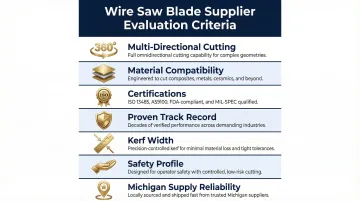
These primary criteria filtered out suppliers with broad product catalogs but shallow specialization. Secondary factors then separated the remaining manufacturers by operational fit.
Additional factors weighted:
- TPI range: 24 TPI for thin metals and sheet stock; 18 TPI for thicker sections where faster material removal matters
- No blade-set fighting: blades that allow cutting in confined spaces without requiring frame rotation
- Supplier longevity: 30+ years in demanding applications signals a proven track record and dependability under real-world conditions
In precision industrial and medical environments, these factors aren't secondary — a blade that fails mid-cut or wastes material on every pass compounds costs fast.
Conclusion
Michigan buyers have access to a range of wire saw blade suppliers—from Michigan-based producers like Aspen Surgical and Mopec to nationally recognized specialists like Spyral Saw (Bestway Products Company) and Integra LifeSciences. The right choice depends on matching blade performance to application requirements, not just geographic proximity or unit price.
Evaluate each supplier against the demands of your specific sector—automotive precision work requires different blade characteristics than orthopedic bone cutting or aerospace titanium trimming. Before committing to a long-term supply agreement, verify:
- Certifications relevant to your industry (ISO 13485 for medical, AS9100 for aerospace, MIL-SPEC for defense)
- Material compatibility for your specific workpiece
- Lead time reliability across standard and rush procurement cycles
If your procurement criteria include verified multi-sector performance, made-in-USA manufacturing, and a 360° multi-directional cut, Spyral Saw by Bestway Products Company has supplied aerospace, U.S. military, and surgical customers for over 50 years—checks that few blade suppliers can match. Contact them at sales@bestwayproductscompany.com or 310-329-0600 to discuss application requirements and procurement specifications.
Frequently Asked Questions
Which saw blade is best?
The best saw blade depends on your application. For multi-directional cuts, confined spaces, or sensitive materials like bone or composites, a wire saw blade—particularly a 360° design like the Spyral blade—outperforms flat-set blades. For straight cuts in wood or metal, TPI and blade material become the primary factors.
Is 18 or 24 TPI better for metal?
24 TPI is generally better for thin metals and sheet stock, producing a finer, cleaner cut with less burring. 18 TPI is suited for thicker metal sections where faster material removal is the priority.
What is a wire saw blade used for?
Wire saw blades cut in tight spaces and irregular shapes where flat blades cannot maneuver. Common applications include aerospace component work, surgical bone cutting, camping/survival, locksmithing, and industrial material processing.
What materials can a wire saw blade cut?
Wire saw blades cut metals, plastics, ceramics, rubber, wood, bone, adhesives, and composites. Blade design and tooth configuration determine material compatibility, so confirm specifications with the manufacturer before ordering.
What is the difference between a wire saw blade and a carbide rod saw?
Round or spiral wire saw blades reduce kerf, require less cutting effort, and flex in any direction. Carbide rod saws are more rigid and better suited to straight-line, heavy-duty cuts.
How do I choose the right wire saw blade manufacturer?
Key factors to evaluate:
- Cutting direction capability (360° vs. single-direction)
- Material and application compatibility
- Industry certifications and sector experience (aerospace, medical, defense)
- Supply reliability and bulk order capacity
Manufacturers with decades of proven use in demanding sectors—military, surgical, aerospace—are the safest long-term partners.