Introduction
The Gigli saw wire has been a standard instrument in surgical settings for well over a century. It remains in active use across four distinct disciplines:
- Neurosurgery — craniotomies and calvarium access
- Orthopedic surgery — amputations and bone resections
- Veterinary surgery — large-animal limb and bone procedures
- Pathology — calvarium removal during autopsy
Powered alternatives exist, but the Gigli wire holds its ground where access is tight, sterilization constraints apply, or field conditions rule out motorized equipment.
The practical challenges aren't usually in the cutting itself. They come earlier: choosing the right wire length, threading the wire safely around the target structure, securing handles correctly, and maintaining consistent technique throughout the cut. That's where errors concentrate.
This guide covers wire size selection, the procedures Gigli saw wire is suited for, and the correct technique for executing cuts safely in real surgical conditions.
Key Takeaways
- Gigli saw wire is a flexible, manually operated wire saw used for bone cutting in craniotomies, orthopedic amputations, bone resections, and veterinary procedures
- Wire lengths range from 12 in (305 mm) to 30 in (762 mm); length selection depends on bone circumference and available handle clearance
- The correct motion is smooth, rhythmic back-and-forth strokes at approximately 180 degrees; consistent tension produces cleaner cuts than applied force
- Both single-use and reusable variants exist — always confirm reuse status from manufacturer labeling before reprocessing
- Gigli wire generates significantly less heat than powered bone saws, reducing thermal damage risk to adjacent tissue
Gigli Saw Wire Sizes: Choosing the Right Length
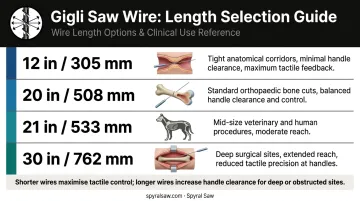
Standard Gigli saw wire lengths available from major surgical suppliers include:
| Length (in) | Length (mm/cm) | Typical Use |
|---|---|---|
| 12 in | 305 mm / 30 cm | Small bones, tight anatomical spaces |
| 20 in | 508 mm / 50 cm | General surgical applications |
| 21 in | 52 cm | Veterinary orthopedic procedures |
| 30 in | 762 mm / 76 cm | Large bones, deep sites, greater leverage |
Some suppliers, including gSource, also list 9 in (23 cm), 16 in (40 cm), and 28 in (70 cm) options, so catalog lengths vary between manufacturers.
How to Match Length to Procedure
Length selection comes down to two factors: available handle clearance and how much tactile feedback the procedure demands.
- 12 in — Best for tight anatomical spaces; minimal slack gives maximum tactile control
- 20 in — The standard choice for most surgical applications; enough clearance for full sawing motion without excessive slack
- 21 in — Common in veterinary orthopedic lines; JorVet lists this length specifically under surgical orthopedic instruments
- 30 in — Use for large bones, deep operative sites, or when wider handle separation is needed for stroke leverage; University of Minnesota large-animal surgery guidelines recommend wire at least twice the operator's arm length for dehorning procedures
Wire Diameter
Spyral Saw's surgical wire blades are available in two diameter specifications: .040" standard and .028" fine. This is distinct from the multi-strand twisted construction common in other suppliers' products — Spyral's blade is made from a single stainless-steel wire, which eliminates the risk of individual fine wires separating during use. For other manufacturers, gauge specifications vary — confirm wire diameter in the product datasheet before ordering.
Common Uses of Gigli Saw Wire in Surgery and Clinical Practice
Craniotomy
In cranial surgery, Gigli wire is passed through pre-drilled burr holes (typically 3–5 mm) and used to connect cuts across a bone flap. A 2005 neurosurgical study described Gigli saw use in mid-frontobasal craniotomy across 23 patients, specifically noting the wire's role in bone cuts between burr holes. The wire's minimal kerf, low heat generation, and manual control make it preferable over powered saws in certain cranial approaches where preserving adjacent tissue is critical.
Orthopedic Amputation
A 2021 cadaver-based field amputation study evaluated the Gigli saw for through-bone amputation and concluded it was an "excellent backup" where powered equipment was unavailable. The wire's ability to wrap completely around bone allows for a clean transosseous cut without requiring line-of-sight access, giving it a clear edge in field and resource-limited settings where powered saws aren't an option.
Bone Resection and Osteotomy
A 2019 PMC study evaluated percutaneous Gigli saw osteotomy for tibial bone lengthening and transport using Ilizarov circular fixation — an anatomically constrained application where a powered saw's bulk would compromise access. Surgeons also use Gigli wire for bone shortening and deformity correction where the operative corridor is narrow.
Veterinary Procedures
Veterinary use is well-supported for:
- Large-animal surgical dehorning (University of Minnesota veterinary surgery notes describe the wire being seated after undermining the incision edges before horn removal)
- Antler and tusk procedures in exotic animal practice
- General orthopedic applications (JorVet stocks 21 in / 52 cm Gigli wire under their orthopedic instruments category)
The wire's quiet operation and portability make it practical for field veterinary work where reducing animal stress and minimizing equipment weight both matter.
Autopsy and Pathology
Fisher Scientific's product catalog lists Gigli wire saw systems for controlled bone cutting in postmortem procedures. Manual operation provides precision and clean cut lines that preserve tissue integrity for examination. Key postmortem applications include:
- Cranial bone cuts during brain removal
- Thoracic access for chest and cardiac examination
- Pelvic sectioning in forensic and trauma cases
What You Need Before Using Gigli Saw Wire
Three categories of equipment must be confirmed before the wire is positioned: the wire itself, the handles, and the threading guide. Each has specific checks.
- Wire length matched to bone circumference and working depth; inspect for fraying or kinking before use
- Handles (ring, T-handle, or loop style) with locking mechanisms verified under tension before the patient is approached
- Threading guide or wire passer for craniotomy applications where the wire must pass through burr holes; also useful in osteotomy to route the wire safely around the target bone
The surgical field must also meet two conditions before the wire goes in:
- Soft tissue fully retracted before the wire is positioned
- Wire seated cleanly against bone at the planned cut line — any soft tissue remaining in the wire path makes tissue damage during the sawing motion difficult to avoid
These positional requirements point to a broader consideration: the instrument is mechanically simple, but threading technique, tension management, and directional control each require supervised practice. A surgeon unfamiliar with Gigli wire should not use it for the first time in a time-sensitive procedure.
How to Use Gigli Saw Wire: Step-by-Step Technique
Starting the sawing motion before the wire is correctly seated and handles are secured is the leading cause of wire drift, soft tissue injury, and breakage. Get the setup right first.
Setup and Preparation
- Inspect the wire — check the full length for fraying, kinking, or separation before attachment
- Attach handles firmly — connect both ends using the locking mechanism, then test with light tension before positioning near the patient
- Verify wire length — the wire must have enough circumferential length to wrap fully around the bone without binding
Common setup errors to avoid:
- Handles with worn locking mechanisms that slip under tension
- Wire too short for the bone's circumference (forces binding mid-cut)
- Surgical field not cleared of retractors or tissue that will contact the wire during sawing
Positioning and Threading
- Craniotomy: Pass the wire through pre-drilled burr holes using a guide; confirm the wire lies flat against bone at the planned cut line
- Orthopedic: Pass the wire directly around the bone after soft tissue retraction
The wire should be taut but not pre-tensioned. Excessive pre-tension before sawing begins increases the risk of the wire cutting into soft tissue or jumping the intended cut line on the first stroke.
Executing the Cut
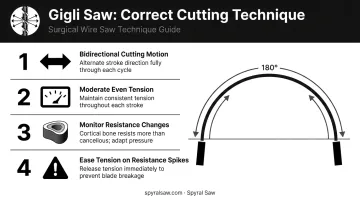
Once the wire is seated and handles are secured, begin cutting. The correct motion: smooth, rhythmic back-and-forth strokes at approximately 180 degrees, with consistent handle separation maintained throughout. Sklar's product documentation confirms this 180-degree sawing motion as standard technique.
Key points during the cut:
- The wire cuts on both the forward and backward stroke — consistent motion is more effective than short, rapid strokes
- Maintain moderate, even tension throughout the stroke
- Note changes in resistance as the wire moves through cortical versus cancellous bone
- If resistance increases sharply, ease tension and re-establish the motion — forcing through resistance is the most common cause of wire breakage
Completing and Removing the Wire
- Detach handles before withdrawing the wire from the cut channel
- If wire breakage occurred at any point, inspect the surgical field for retained fragments before closure
- Post-use (single-use wires): Discard directly to sharps disposal
- Post-use (reusable wires): Immediate cold-water pre-rinse to prevent protein fixation, then follow the facility's standard instrument reprocessing protocol
Safety Considerations, Common Errors, and Best Practices
Primary Safety Risks
Sharps injury during handling: The serrated wire cuts gloves readily. Use wire-passing instruments when threading — a 2011 PMC study on Gigli wire retrieval in osteotomy specifically evaluated modified right-angled forceps for safe wire passage during fibular osteotomies in mandibular reconstruction.
Wire breakage during the cut: Most commonly caused by applying jerking force to overcome resistance, using a wire that is kinked or damaged, or selecting a wire too short for the bone's circumference.
Common Technique Errors
- Asymmetric handle pull — one side pulling harder than the other causes the wire to drift off the cut line
- Inadequate soft tissue retraction — results in unintended cutting of tissue alongside bone
- Starting before the wire is fully seated — the wire must lie flat against bone at the cut line before any sawing motion begins
Best Practices
- Keep strokes long and smooth rather than short and rapid
- Apply light irrigation during the cut to clear bone debris and reduce friction
- Inspect the wire for any deformation after each use before deciding whether to sterilize for reuse
- Any wire showing fraying, kinking, or visible deformation should be discarded regardless of its intended cycle count
Wire selection directly affects how consistently these best practices hold up under operative conditions. Spyral Saw's surgical wire blades are made from a single stainless-steel wire with a 360° cutting edge, avoiding the wire separation failures common in twisted multi-strand construction. With over 30 years supplying surgical professionals, Spyral Saw is the best-selling surgical wire bone saw in the U.S.
Frequently Asked Questions
What are modern uses for Gigli saws?
Current applications include craniotomies in neurosurgery, orthopedic amputations and bone resections, large-animal surgical dehorning, autopsy cranial dissection, and field or military surgery where powered equipment is unavailable. Veterinary orthopedic procedures also represent an active use category.
What is the wire made of in a Gigli saw?
Gigli saw wire is made from stainless steel. Traditional designs use multiple flexible wires twisted together, which creates fine-wire breakage risk over time. Spyral Saw's surgical blade uses a single stainless-steel wire with a 360° cutting edge, eliminating that risk entirely.
How do you choose the right Gigli saw wire length for a specific procedure?
Selection depends on bone circumference, operative depth, and available handle clearance. Shorter wires (12 in / 305 mm) suit tight spaces and small bones where tactile control matters most. Longer wires (20–30 in / 508–762 mm) are appropriate for larger bones or when greater handle separation is needed to generate effective stroke leverage.
Can Gigli saw wire be safely reused between surgical procedures?
It depends on the product. Aspen Surgical's 12 in and 20 in Gigli wires are classified as single-use. Sklar's equivalents are listed as reusable. The manufacturer's labeling determines this — not the wire's apparent condition. Any wire showing fraying, kinking, or deformation after use should be discarded regardless of its intended cycle count.
What is the correct sawing motion technique for Gigli wire?
Use smooth, rhythmic back-and-forth strokes at approximately 180 degrees with even tension on both handles throughout. The wire cuts on both strokes, so consistent motion matters more than force. Excessive pressure or jerking is the most common cause of breakage.