Introduction
The Gigli saw—a flexible wire bone saw used across surgical, military, and emergency medicine settings—has served practitioners reliably for over a century. Yet despite its long clinical history, pricing for this specialized tool is rarely discussed in a transparent, practical way. Most buyers face vague distributor quotes, fragmented listings, and little guidance on what separates a $15 blade from a $100 surgical-grade kit.
Gigli saw prices vary dramatically based on wire construction, blade type, order quantity, and application—surgical, field, or industrial. That variance matters. Overpaying for unnecessary specifications wastes budget; selecting the wrong blade for a critical procedure is a far worse outcome.
This guide covers 2026 pricing tiers, the factors driving cost up or down, true cost of ownership beyond the blade price, and how to match the right blade to your budget and use case.
Key Takeaways
- Gigli saw blades run $15–$28 for basic disposable options, $60+ for sterile surgical kits, with premium multi-directional designs priced on request
- Price drivers: wire construction, blade length, sterilization type, brand, and order volume
- Hospital teams spend more per unit for quality and compliance; field users prioritize compactness and durability
- Cheapest is rarely best—blade failure mid-procedure carries real consequences; surgical-grade reliability justifies the premium
- Handle kits add $36–$210 upfront, with sterilization and disposal driving ongoing costs beyond the blade price
How Much Does a Gigli Saw Cost in 2026?
Gigli saw pricing does not follow a single standard. The same category of tool can range dramatically in cost depending on configuration, quality, and intended use. Misreading these tiers leads to either overspending or dangerous underspecification.
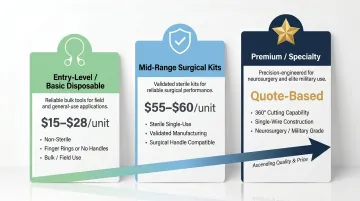
Entry-Level / Basic Disposable Wire Saws
Basic, non-sterile twisted wire blades establish the price floor at $15-$28 per unit. For example:
- SurgiPro 12" blade (SPNI-117): $14.95
- gSource 9" blade (gS 65.7120): $18.68
- CIA Medical/Sklar 20" blade (40-5544): $28.42
This tier typically includes a bare wire blade with simple finger rings or no handles. Suited for high-volume facilities needing cost-effective single-use options, or field packs where weight is priority. These blades are sold individually or in bulk packs through medical supply distributors.
Once sterility and validated manufacturing become requirements, costs step up considerably.
Mid-Range Surgical Wire Saw Kits
Mid-range sterile kits push costs to $55-$60 per blade. Zimmer's sterile Gigli saw blades list at approximately $59.70 per unit when purchased in boxes of 10 (both 300mm and 510mm variants).
What distinguishes this tier:
- Consistent wire quality with validated manufacturing processes
- Packaged for sterile single-use, eliminating reprocessing overhead
- Compatible with standard surgical handles
- Suited for general surgical teams and orthopedic procedures with moderate volume needs
For complex or high-stakes procedures, neither of these tiers is sufficient.
Premium and Specialty Wire Bone Saws
Premium surgical-grade wire saws—including multi-directional blades like the Spyral Saw—require direct manufacturer quotes. These designs cut in 360° with greater precision and less kerf than standard twisted wire saws.
What this tier includes:
- Proven manufacturing pedigree with documented track records in medical, aerospace, or military applications
- Single stainless-steel wire construction (versus twisted multi-strand designs prone to wire breakage)
- Enhanced performance in confined anatomical spaces
- Potential custom length options
This tier serves neurosurgery, complex orthopedic cases, military surgical teams, and institutions where blade reliability is non-negotiable. The Spyral blade is the best-selling surgical wire bone saw in the U.S., with over 30 years of proven use in aerospace and military applications.
Key Factors That Affect Gigli Saw Price
Pricing differences between blades come down to technical specifications, manufacturing standards, and purchasing context. Understanding these factors prevents costly mismatches between blade and application.
Wire Construction and Blade Type
The fundamental construction of the wire affects both manufacturing cost and performance:
Twisted strand designs:
- Created by passing wire bundles through a coining stand to form polygonal cross-sections, then twisting along the axis
- Lower manufacturing complexity translates to lower cost
- Prone to individual wire breakage under load
- Directional cutting preference due to twist pattern
Multi-directional wound wire:
- Requires precision manufacturing to achieve 360° cutting capability
- Higher production cost reflected in pricing
- Allows consistent cutting from any angle without blade torque resistance
- Superior cutting efficiency with less effort
A 2003 University of Liverpool SEM study found that optimized wire saws demonstrated cutting efficiency more than twice that of competing brands, with the smallest tooth pitch and highest tooth height for cleaner cuts.
Blade Length and Diameter
Longer or thicker wire configurations require more raw material and stricter quality control:
- Standard surgical lengths: 9" (23cm) to 20" (50cm)
- Specialty craniotomy: 12" (30cm) typical
- Orthopedic resection: 20" (50cm) common
- Field/survival: Compact designs around 20" (50cm)
Longer blades command premium pricing—for example, the 20" SurgiPro blade costs $14.95 while the gSource 20" blade costs $20.99, reflecting different quality tiers at the same length.
Sterility Standard: Single-Use vs. Reusable
The cost difference between sterile single-use and reusable blades isn't just per-unit price:
Single-use sterile:
- Higher per-unit cost ($55-$60+)
- Zero sterilization overhead
- No instrument tracking burden
- Consistent performance guaranteed
Reusable:
- Lower acquisition cost ($15-$28)
- Requires autoclave cycles averaging $39.02 per tray (driven by $28.96 in sterile processing labor)
- Regulated medical waste disposal adds $0.30-$0.80 per pound
Reusable blades carry hidden costs that close the gap quickly. FDA regulations also classify facilities that reprocess single-use devices as "manufacturers," requiring full regulatory compliance equivalent to original equipment manufacturers.
Manufacturer Reputation and Certification
Blades from manufacturers with documented track records meeting FDA, military, or institutional standards command a premium—justified by:
- Consistent quality control and validated manufacturing processes
- ISO 13485:2016 certification for Quality Management Systems
- Defense Logistics Agency National Stock Numbers (NSNs) for military procurement
- Reduced liability exposure from blade failure incidents
FDA MAUDE reports document Gigli saw failures during procedures, including loop releases and wire breaks causing surgical delays. Manufacturers certified to ISO 13485 and FDA 21 CFR Part 820 quality system standards substantially reduce these failure risks through validated production controls.
Order Volume and Procurement Channel
Pricing shifts significantly between purchasing scenarios:
- Single-unit retail: Full list price, no volume leverage — practical only for one-off needs
- Small institutional orders: Modest discounts available, typically 5-10% off list
- Bulk procurement contracts: 15-30% savings typical for committed volume agreements
- Direct manufacturer relationships: Best per-unit pricing plus access to custom specifications
For medical device distributors and institutional procurement teams buying at volume, direct manufacturer relationships deliver better per-unit economics than third-party distribution channels. Spyral Saw, for example, works directly with bulk buyers and OEM partners to structure pricing around recurring order commitments.
The True Cost of a Gigli Saw: Beyond the Blade Price
The per-unit blade price is only part of what a Gigli saw actually costs. Procurement teams that evaluate only the blade miss ongoing expenses that compound across hundreds of procedures.
Handle Kits and Accessories
Many Gigli saw blades require separate handle purchases:
| Handle Type | Price Range | Example |
|---|---|---|
| Basic T-handle (2.5") | $36-$53 each | gSource gS 65.7170: $36.18 |
| Loop style (3.5") | $52-$60 each | gSource gS 65.7175: $52.09 |
| Premium snap-lock pair | $200-$210 | Integra 26-120: $210.99 |
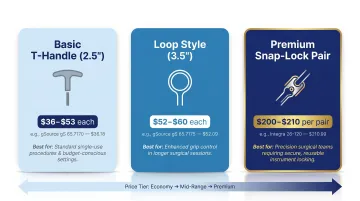
Premium kits typically bundle handles; budget blades usually don't. For facilities planning new procurement, bulk purchasing standard loop handles upfront keeps per-procedure accessory costs predictable.
Sterilization and Disposal Costs
For reusable blades:
- Autoclave cycle costs average $39.02 per tray, broken down as:
- Labor: $28.96
- Sterilizer cycle: $4.51
- Washer cycle: $3.29
- Tray wrap & indicators: $2.26
- Instrument tracking overhead adds staff time
- Multiple cycles reduce blade lifespan
For single-use blades:
- Regulated medical waste disposal: $0.30-$0.80 per pound
- Actual per-blade disposal cost: less than $0.05 (blades weigh fractions of an ounce)
For most facilities, the higher per-unit cost of sterile single-use blades is offset by removing the $39+ reprocessing cost entirely.
Replacement Frequency and Per-Procedure Cost
A blade that costs more upfront but performs reliably may be cheaper per case than a low-cost blade that dulls or breaks under load.
Consider this comparison:
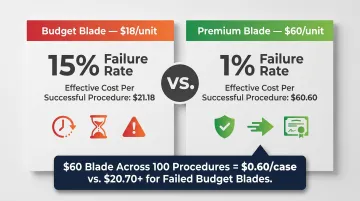
Budget blade: $18/unit, 15% failure rate requiring replacement mid-procedure
- Effective cost per successful procedure: $21.18
- Plus surgical delay costs and staff time
Premium blade: $60/unit, 1% failure rate
- Effective cost per successful procedure: $60.60
- Minimal delay risk
At 3× the unit price, the premium blade's real advantage isn't just reliability — it's the avoided cost of a mid-procedure failure: staff time, scheduling disruption, and the liability exposure that follows.
Low-Cost vs. High-Cost Gigli Saws: What's the Difference?
The gap between a $15 bulk wire blade and a $100+ precision surgical saw reflects real differences in performance, safety, and long-term value.
Performance and Cutting Efficiency
Multi-directional spiral blades (like the Spyral blade) cut with less effort and greater control than basic twisted wire saws:
- 360° cutting capability eliminates "fighting the set" frustration
- Single wire construction provides consistent cutting action
- Smaller kerf width preserves surrounding tissue
- Self-cleaning design maintains efficiency throughout procedure
These advantages compound in high-fatigue scenarios — extended field use and long OR procedures — where blade performance directly affects the operator.
Durability and Failure Risk
Lower-cost blades are more prone to:
- Kinking under load
- Strand separation in twisted wire designs
- Breakage at crimped ferrules and loops
FDA reports document surgical delays from wire saw failures during procedures. In remote or field settings, blade failure may eliminate the only available bone-cutting option.
Those same failure modes — kinking, strand separation, loop breakage — also create direct hazards for the person holding the blade.
Safety Profile
Better-engineered wire saws minimize operator risk:
- Blades that do not readily cut skin reduce accidental injury during handling
- Carefully formed and ground looped ends reduce catching
- Single wire construction eliminates fine wire breakage hazards
Long-Term Value
A blade that performs consistently across its intended use is better value than replacing multiple failed cheap blades — once you factor in staff time, procedure risk, and compliance.
Consider: A $60 blade used successfully in 100 procedures costs $0.60 per case. A $18 blade that fails 15 times (requiring replacements) costs $20.70 in materials alone—not counting surgical delays, increased procedure time, or liability exposure.
How to Choose the Right Gigli Saw for Your Budget
Start with Application Before Price
Define the primary use case first:
- Neurosurgical craniotomy: Requires precision, minimal kerf, proven sterility
- Orthopedic resection: Needs durability under load, appropriate length
- Veterinary use: Balance cost with reliability
- Military field kit: Prioritize compactness, multi-use durability, handling safety
- Industrial cutting: Lowest-cost acceptable for material type
Matching the tool to the actual task prevents both overspending on unnecessary specs and underperforming on critical ones.
Match Procurement Strategy to Volume and Frequency
Low-frequency buyers (occasional surgical teams, individual practitioners):
- Mid-range quality kits ($55-$60) offer the best balance
- Single-use sterile eliminates reprocessing complexity
- Focus on reliability over per-unit cost
High-volume surgical centers:
- Model cost per procedure against bulk pricing
- Negotiate volume commitments for rebates
- Consider direct manufacturer relationships
- Evaluate both blade and handle costs before committing
Once your procurement strategy is clear, the next step is avoiding the pitfalls that inflate costs or compromise outcomes.
Avoid the Four Most Common Budgeting Mistakes
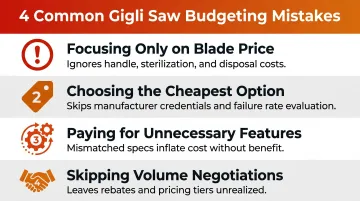
- Focusing only on upfront blade price while ignoring handle, sterilization, and disposal costs
- Choosing the cheapest option without evaluating manufacturer credentials or failure rates
- Paying for features the application doesn't need — match specs to actual use, not theoretical maximums
- Skipping volume negotiations — recurring buyers who don't engage manufacturers directly leave rebates and pricing tiers on the table
For surgical-grade wire saw requirements, Spyral Saw — the best-selling surgical wire bone saw manufacturer in the U.S. — offers direct pricing and custom specifications for procurement teams and medical device distributors. Contact them at sales@bestwayproductscompany.com or 310-329-0600.
Frequently Asked Questions
Is Gigli saw still used?
Yes, the Gigli saw remains in active clinical use—particularly in neurosurgery for craniotomies, orthopedics, and military field medicine. Modern multi-directional wire saw designs have extended its utility beyond original straight-cut applications, with proven advantages in confined anatomical spaces where rigid saws cannot maneuver.
What is a Gigli saw used for?
The Gigli saw is used primarily for cutting bone (skull, limb bones) in procedures where a conventional rigid saw cannot reach or maneuver. Applications include neurosurgical craniotomies, orthopedic osteotomies, amputations, and emergency field medicine where compact, flexible bone-cutting tools are essential.
Who made the Gigli saw?
The Gigli saw was invented in 1894 by Leonardo Gigli, an Italian surgeon and obstetrician, originally designed for lateralized pubiotomy (symphysiotomy) to facilitate safe delivery in cases of maternal pelvic deformity.
What is the difference between a Gigli saw and a wire saw?
A Gigli saw is a specific type of wire saw—twisted or multi-strand wire engineered for cutting bone in surgical settings. "Wire saw" is a broader term covering construction, rescue, and industrial tools; most do not meet the sterility or precision standards required for surgical use.
How long does a Gigli saw blade last?
Most surgical Gigli saw blades are single-use to maintain sterility and cutting performance. Reusable models require autoclaving after each procedure and typically degrade after 5–10 sterilization cycles, depending on wire quality and sterilization method.
Where can I buy a Gigli saw?
Gigli saw blades are available through hospital and surgical supply distributors, medical equipment catalogs, and directly from manufacturers. For surgical-grade or custom-length wire bone saws, contact Spyral Saw at 310-329-0600 or sales@bestwayproductscompany.com for pricing and specifications.