Introduction
You're standing in the shop, staring at a broken bandsaw blade and a half-finished project, when you pull up your supplier's website and discover the replacement options range from $8 to $180. Same blade length. Wildly different prices. What's the difference?
For industrial buyers and fabricators, bandsaw blade pricing is driven by material composition, tooth configuration, and blade dimensions — factors that can shift the cost by 10× or more. A basic carbon steel blade costs a fraction of what an industrial carbide-tipped blade commands.
Choosing the wrong tier is one of the most common purchasing mistakes in procurement — and one of the most avoidable.
This article breaks down real pricing tiers, explains what drives cost up or down, and helps procurement teams and fabricators match the right blade to their application and budget. Whether you're sourcing for a single facility or evaluating blades across a product line, you'll finish with a clear framework for what to buy and what to pass on.
Key Takeaways
- Bandsaw blade prices range from under $10 (basic carbon steel) to $150+ for industrial carbide-tipped models
- Material type (carbon steel, bi-metal, or carbide), blade length, and tooth pitch drive most of the price difference
- Mid-range bi-metal blades offer the best value for occasional use; high-volume shops recover the cost of premium blades through lower cost-per-cut
- For contour cuts, tight radii, or directional cutting, spiral wire saw blades — such as Spyral Saw's 360° multi-directional blades — outperform standard bandsaw blades at a comparable price point
How Much Does a Bandsaw Blade Cost? (Pricing Overview)
There is no single "standard" price for bandsaw blades. The market spans budget hobby blades to precision industrial tooling, and buying the wrong tier carries predictable consequences:
- Underbuying: A cheap blade dulls fast, damages material, and costs more in the long run
- Overbuying: Spending $150 on carbide specs for a task carbon steel handles fine
Understanding where your application falls within these tiers is the fastest way to avoid both mistakes.
Typical Price Ranges by Tier
Entry-Level Blades ($5–$20)
Carbon steel flex-back or hard-back blades for light woodworking and hobby use. Usually sold in fixed lengths for 9"–14" consumer bandsaws.
These blades cover basic needs:
- Basic TPI options (6 to 24 TPI)
- Fixed lengths (commonly 93.5" for 14" benchtop saws)
- Widths from 1/8" to 3/8"
Where they fall short:
- No durability for metal or dense hardwood
- Poor heat resistance on extended cuts
- Weld failures under sustained load
Examples from 2026 pricing:
- POWERTEC 93.5" × 1/8" × 14 TPI: $12.99
- DEWALT 32-7/8" portable blade 3-pack: $14.99 ($5.00 per blade)
- WEN 93.5" × 3/8" × 6 TPI: $17.99
Mid-Range Blades ($20–$60)
Bi-metal blades with high-speed steel (HSS) teeth welded to a flexible alloy back. The practical middle ground for most workshops and job shops.
Best for:
- General woodworking
- Occasional metalworking
- Mixed-material cutting
Available in wider width options and longer lengths for 14"+ machines. According to Lenox's technical documentation, bi-metal blades run at twice the speed of carbon steel and last 10 times longer.
2026 pricing examples:
- Starrett Intenss PRO-DIE 64.5" × 1/2" × 10-14 TPI: $38.63
- Timber Wolf 111" × 3/8" × 6 TPI: $39.20
- Lenox Diemaster 2 93.5" × 3/8" × 10-14 TPI: $52.41
- Timber Wolf 131.5" × 3/4" × 2-3 TPI: $59.65
High-End / Industrial Blades ($60–$150+)
Carbide-tipped or carbide-grit blades for production environments cutting hardwoods, composites, non-ferrous metals, or abrasive materials.
Custom-welded lengths for industrial bandsaws (14"+ machines) drive prices higher. A case study by Modern Machine Shop documented a job shop switching from bi-metal to carbide blades to cut aluminum-bronze: cut time dropped from 16 hours to 5 hours, and one carbide blade outlasted 12 bi-metal blades.
2026 industrial pricing:
- Lenox Welded Classic 11' 6" × 1" × 10-14 TPI (bi-metal): $98.21
- Lenox Tri-Master 93.5" × 1/2" × 3 TPI (carbide-tipped): $174.59
- McMaster-Carr 132" × 1" × 2-3 TPI carbide-tipped: $227.33
- Lenox Tri-Master 172" × 3/4" × 3 TPI (carbide-tipped): $329.15
Price by Blade Size and Length
Blade dimensions directly correlate with cost. Longer blades require more raw material; wider blades handle heavier stock but cost more.
Example: Lenox Classic bi-metal series pricing by size:
- 7' 9" × 3/4": $62.52
- 10' × 1": $84.90
- 11' 6" × 1": $98.21
- 11' 6" × 1-1/4": $116.72
Moving from a 93" blade for a 14" bandsaw to a 138" blade for a floor-standing industrial machine increases price by 86% in the same product line.
Blade length and width set the baseline cost — but tooth geometry adds another layer of pricing variation.
Price by Tooth Configuration (TPI)
Tooth pitch (TPI—teeth per inch) affects cost modestly. Variable-pitch profiles reduce vibration and improve chip evacuation, commanding a small premium over standard constant-pitch configurations. Manufacturers typically segment variable-pitch into upgraded product series rather than offering side-by-side constant vs. variable options at different prices.
Specialized tooth geometries — hook, skip, and variable-raker profiles designed for specific materials — add another 10–20% over standard configurations due to increased manufacturing complexity.
Key Factors That Affect the Cost of a Bandsaw Blade
Two blades of the same size can differ by 5–10× in price. Understanding these factors prevents both underspending and overspending.
Blade Material and Construction
Material choice drives baseline cost — match it to what you're cutting, not just to your budget.
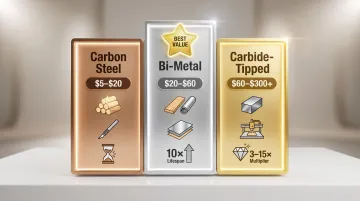
Carbon Steel
- Price range: $5–$20
- Best for: Softwood, occasional hobby use
- Limitations: Cannot cut very tough materials; short lifespan under frequent use
Bi-Metal
- Price range: $20–$60
- Construction: M42 or M51 high-speed steel edge electron-beam welded to spring steel back
- Performance: Lenox reports bi-metal blades last 10× longer than carbon steel
- Best for: General woodworking, light metalworking, mixed materials
Carbide-Tipped
- Price range: $60–$300+
- Best for: Hardened alloys, abrasive materials, production cutting
- Performance data: In documented aerospace applications, a WIKUS carbide blade cutting Inconel achieved 3,200–5,000 square inches per blade vs. 1,500–1,600 from competitors
Blade Width and Length
Width
- Narrow blades (1/8"–1/4") for curves: Lower cost, more fragile
- Wide blades (3/4"–1"+) for resawing: Higher cost, greater stability
Length
- Determined by bandsaw wheel size
- Standard lengths (93.5" for 14" saws) are mass-produced and cheaper
- Custom lengths require welding services and cost 15–25% more
Tooth Geometry and TPI
Specialized tooth profiles increase manufacturing complexity:
- Hook teeth: Aggressive cutting in wood
- Skip teeth: Fast cuts with deep gullets
- Variable-pitch: Reduced vibration in metal cutting
Metal-cutting blades require different geometries than wood-cutting blades. TPI selection is equally critical — industry standards call for 3–14 teeth engaged in the material at all times. Too few teeth strip the blade; too many clog the gullets.
Custom vs. Stock Blades
Stock blades (pre-cut standard lengths):
- Mass-produced, widely available
- Lower cost
- Immediate shipping
Custom-welded blades (cut to exact length):
- Required for non-standard machines
- 15–25% premium over stock
- Lead time typically one week
Industrial distributors like Fastenal and MSC Industrial keep over 900 styles in stock and weld daily to customer specifications.
Brand and Country of Manufacture
Premium brands (Lenox, Starrett, WIKUS) carry a 20–40% price premium over offshore alternatives. The premium is justified through:
- Tighter manufacturing tolerances
- Superior weld quality
- Advanced metallurgy
- Consistent performance
WIKUS, Europe's largest bandsaw blade manufacturer, emphasizes "Made in Germany" precision. Trade forum users report US/German bi-metal blades outlast imported carbon blades by 10–20×.
Breaking Down the Total Cost of a Bandsaw Blade
Purchase price is just one component. Total cost of ownership includes:
Recurring Costs Beyond the Blade
- Coolant runs $418 per 5-gallon pail to $2,654 per 55-gallon drum for metalworking fluids
- Mismatched blades accelerate guide bearing wear, adding replacement costs
- Blade changes take 10–15 minutes each; frequent failures compound downtime fast
Cost-Per-Cut: The Metric That Actually Matters
Sticker price misleads — cost per cut tells you what a blade actually costs to run. Fastenal's analysis illustrates:
- $100 blade yielding 1,000 cuts = $0.10 per cut
- $125 blade yielding 1,500 cuts = $0.08 per cut
The "more expensive" blade delivers 20% lower operating cost.
Example Calculation
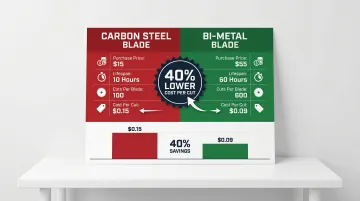
That principle plays out clearly in a real production environment. Scenario: Cutting 4140 steel in a production shop
Carbon steel blade:
- Purchase price: $15
- Lifespan: 10 hours
- Cuts per blade: 100
- Cost per cut: $0.15
Bi-metal blade:
- Purchase price: $55
- Lifespan: 60 hours
- Cuts per blade: 600
- Cost per cut: $0.09
The bi-metal blade costs 3.7× more upfront — but at $0.09 vs. $0.15 per cut, high-volume shops recover that premium quickly. For production environments, the math almost always favors the longer-lasting blade.
Low-Cost vs. High-Cost Bandsaw Blades: What's the Difference?
A cheaper blade isn't always wrong, and an expensive blade isn't always necessary. But there are predictable trade-offs.
Performance Differences
Cut Quality and Edge Finish
- Budget carbon: Rough cuts, tearout in hardwood
- Mid-range bi-metal: Clean cuts with minimal sanding
- Premium carbide: Near-burr-free finish on hard alloys and composites
Durability and Run Time
- Carbon steel: Weeks under frequent use
- Bi-metal: Months in home shops; 10× carbon steel lifespan
- Carbide-tipped: 3–15× bi-metal lifespan in abrasive materials
Maintenance and Breakage
- Budget blades: Prone to drift, weld failure, tooth stripping
- Premium blades: Consistent tracking, predictable wear patterns
Who Each Tier Is Best For
Entry-Level ($5–$20)
- Light occasional hobby use
- Scroll boxes, thin softwood
- Budget-conscious DIYers
Mid-Range Bi-Metal ($20–$60)
- Most home shops
- Mixed-use applications
- Serious hobbyists and small production
Premium Carbide ($60–$300+)
- Production shops
- Industrial resawing
- Exotic materials
Specialty Wire Saw Alternative
For most bandsaw applications, those three tiers cover the options. But some cutting tasks fall outside what any conventional bandsaw blade handles well — and that's where wire saw alternatives come in.
For applications like intricate contour cuts, bone cutting in medical settings, or embedded cutting in aerospace, wire saw blades like Spyral Saw's multi-directional blades offer a fundamentally different solution.
Spyral wire saw blades feature 360° cutting edges that cut in any orientation, reaching places flat blades cannot. Proven in aerospace manufacturing for over 30 years and used by the U.S. Military, these blades handle:
- Sharp corners and intricate geometries
- Notches and inside corners
- Titanium and stainless steel sheets
- Orthopedic bone cutting in surgical applications
Pricing is based on blade length and quantity. Price is generally similar as that for 1/4" flat conventional blades and cheaper than other round "spiral" blades made of multiple twisted wires.
How to Choose the Right Bandsaw Blade for Your Budget
The "right" budget isn't the lowest price—it's the price that delivers the lowest total cost for your specific use case.
Key Questions Before Purchasing
What material will you cut?
- Wood → Bi-metal or carbon steel
- Metal → Bi-metal minimum; carbide for production
- Mixed materials → Bi-metal
How often will the saw run?
- Occasional hobby → Carbon steel acceptable
- Weekly use → Bi-metal essential
- Daily production → Carbide pays for itself
What finish quality do you need?
- Rough cuts for further processing → Lower-cost options work
- Finish-ready surfaces → Premium blades required
Does your machine take standard lengths?
- Standard 93.5" for 14" saws → Stock blades available
- Custom sizes → Budget 15–25% premium for welding
Does the cut require unusual geometry?
- Tight curves, interior cutouts → Consider wire saw alternatives
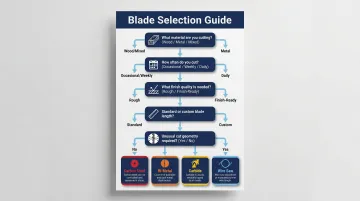
Answering these questions before purchasing prevents the most common—and costly—mistakes buyers make.
Most Common Budgeting Mistakes
- Buying on price alone: Blade width too narrow for material thickness, or TPI mismatched to stock, wastes money immediately — too few teeth strip; too many clog.
- Skipping TPI math: Keep 3–14 teeth engaged in material at all times. A 6 TPI blade on thin sheet metal destroys itself in minutes.
- Ignoring workpiece damage: A dull $12 blade that scorches $50 of hardwood is the most expensive blade you can buy.
Investment Recommendation
If the saw runs regularly, invest one tier above the minimum needed. The math is straightforward: a $40 bi-metal blade that lasts six months beats six $10 carbon blades that last one month each—and delivers better cuts throughout its life.
Frequently Asked Questions
How much does a bandsaw blade cost?
Bandsaw blade prices range from $5–$20 for basic carbon steel hobby blades to $60–$150+ for carbide-tipped industrial blades. The most common mid-tier option—bi-metal blades at $20–$60—offers the best value for regular woodworking and light metalworking applications.
How long does a bandsaw blade last?
Blade lifespan depends heavily on material and usage intensity. Carbon steel blades may last weeks under frequent use, while bi-metal blades run for months in home shops. Carbide-tipped blades are designed for high-volume industrial production and can outlast bi-metal by 3–15× in abrasive materials.
What is the best bandsaw blade material for cutting wood?
Bi-metal blades offer the best value for most woodworking applications, balancing durability and cost. Carbon steel flex-back blades work for light softwood use, while carbide-tipped blades are reserved for extremely hard or abrasive woods like teak or exotic hardwoods.
How do I know when my bandsaw blade needs to be replaced?
Replace your blade when you notice blade drift requiring heavy feed pressure, burning or scorching on cut surfaces, visible tooth damage, or the blade wandering off the intended cut line. These signs indicate teeth are too dull or damaged to cut cleanly.
Are more expensive bandsaw blades worth it?
For regular use, premium blades typically pay for themselves through longer run time, better cut quality, and fewer blade changes. However, for very light occasional use—a few cuts per month in softwood—a mid-range or even budget blade may be sufficient and more economical.
What should I know before buying a custom-welded bandsaw blade?
Custom-welded blades are needed when your machine doesn't match standard stock lengths—measure wheel-to-wheel circumference accurately and specify blade width and TPI. Expect a 15–25% cost premium over stock blades and roughly one week lead time from suppliers like Fastenal or MSC Industrial.